Conflict
Life in war-torn Lebanon: refuge in a football stadium


Zeina Sarhan marked her 67th birthday in a tent. She spent the day with her 60-year-old sister, Hosna, inside a plastic-sheet shelter at Beirut’s Camille Chamoun Sports City Stadium. Hosna has shared her life for 45 years and still prepares her morning coffee just as she used to at home. Neighbours from the adjacent row of tents came to sit with them as well. Children darted along the running track, threading their way between lines of stretchers. Near the entrances, women distributed food they prepared on shared stoves.
The complex, which can accommodate more than 49,500 spectators, normally serves as a venue for football matches and national events. It has now taken on a completely different role and houses around 1500 displaced people. After Israeli airstrikes on Lebanon began in the latest escalation involving the Lebanese Shia militant group Hezbollah, the stadium was turned into a refuge for families forced to flee the south of the country. It is one of hundreds of collective shelters currently in operation across the country, many of which are overcrowded and lack adequate sanitation facilities.
Zeina and Hosna Sarhan come from Al-Duwair, a village in southern Lebanon. Two years ago, their family home was destroyed during the Israeli invasion. Afterwards, they fixed up a small house their father had built decades earlier and stayed there together until fighting resumed this year. Displaced once more, they spent several nights sleeping by the roadside before eventually reaching the complex, where they found shelter. “Everything is provided here, even medicine,” Zeina Sarhan says. “We are grateful, but it’s not home.”
Although a ceasefire came into effect on 16 April, Israeli attacks continued. By the end of April, 2576 Lebanese had been killed and 7962 injured, according to the country’s National News Agency.
Sharing a tent with strangers in the stadium
The two sisters are among the more than 1.2 million people displaced in Lebanon, roughly a fifth of the country’s population. They do not know what lies ahead. “Even if there is a ceasefire, we cannot return to our village. It’s dangerous,” Zeina Sarhan says.
Huda Zein El-Din, 42, is from the southern village of Safad al-Battikh. She exchanged a 250-square-metre house with a garden for a tent she now shares with strangers. “They have become my family,” she says, “because we share the same loss.” Once the ceasefire came into effect, she briefly ventured back to her village and collected her gold and savings. A few days later, renewed Israeli threats drove her out once again. She says she has neither grown used to life in a tent nor does she wants to. But she has decided that wherever she finds an apartment, she will take one of her tent neighbours with her.
Mohammed, a young man with autism, was taken to Sports City from Beirut’s southern suburbs. Repeated explosions just a few hundred metres away left him deeply distressed. It took weeks of support from paramedics and shelter staff before he slowly became accustomed to the noise.
Many displaced people lack a source of income
For others who have found shelter in the stadium, the biggest disruption has been financial. Abu Ahmed Koudami, 60, arrived with his son from the southern village of Jouaiya, while his wife and daughter went to stay with his sister-in-law. The first days were difficult, he reports: rain seeped into the tents, and nerves were strained, though conditions later improved.
“We are villagers, there is no work for us in Beirut,” Koudami says. Most displaced people have no source of income. Many have sold their gold or whatever possessions they still had in order to get by. The escape was sudden, Koudami adds, and no one had been prepared for it.
Naji Hammoud, the complex’s stadium director, says Sports City is being expanded to accommodate another 1000 people. The government has reserved one wing for people with disabilities, with accessible corridors and bathrooms, while the Lebanese Red Cross is on site every day to provide medical care for all displaced residents. “Most residents stayed during the ceasefire because they have nowhere else to go,” he says. “Families fear the war could return at any moment.”
Devastating Israeli air strikes on Lebanon
As of late April, the government’s Disaster Risk Management Unit (DRM) listed 626 official shelter centres housing 119,623 displaced people. “The remaining 85 % are in rented homes or staying with relatives, in conditions that are unstable,” says Nasser Yassine, director of the Arab Center for Research and Policy Studies.
A report by the UN Office for the Coordination of Humanitarian Affairs (OCHA) states that more than 1400 buildings have been destroyed since 2 March. Particularly devastating was a strike on the Qasimiyeh bridge, a key route linking southern Lebanon with the rest of the country. Its destruction has hampered humanitarian access to areas south of the Litani River. In addition, 161 attacks on healthcare facilities were recorded by mid-May, in which 110 healthcare workers were killed and 252 injured.
Schools have become shelters
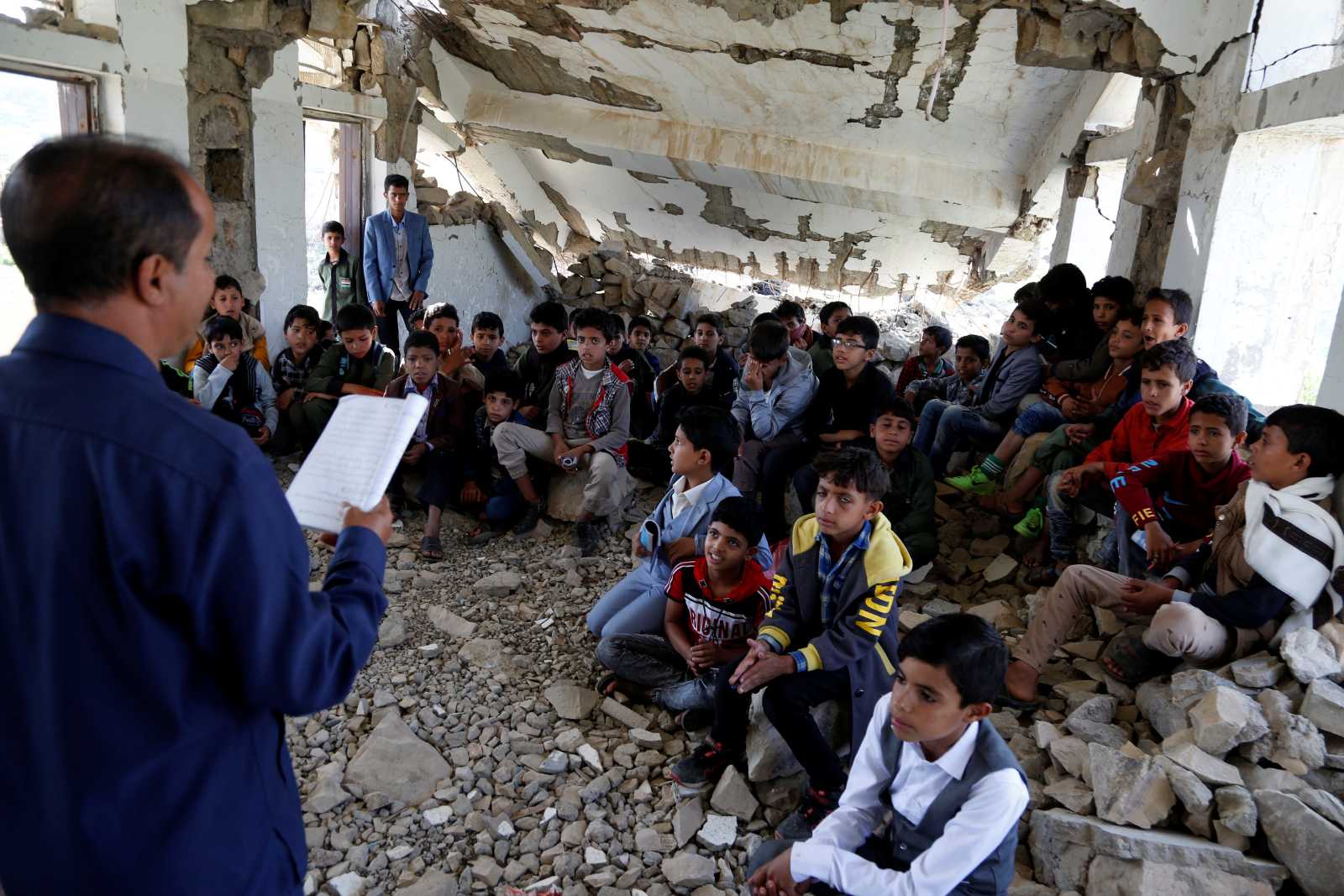
According to the UNHCR, more than 390,000 children are among the displaced. The Ministry of Education has attempted to offer a combination of face-to-face and distance learning, but as of 2024, Save the Children had recorded nearly 500 schools that had been converted into emergency shelters, suggesting that these measures have had only a limited impact.
Minister of Social Affairs Haneen Sayed told the press at the end of March that international aid was covering only about 30 % of Lebanon’s needs. She added that during the 2024 war, which lasted just over two months, the UN raised $ 700 million to help Lebanon deal with the humanitarian fallout. As the country enters the second month of a new war, it has received only $ 30 million from the UN’s latest appeal. Donors have pledged another $ 60 million.
The Lebanese Institute for Market Studies estimates Lebanon’s direct and indirect financial losses from the war at an initial $ 5 billion as of the end of April. But the figures remain preliminary. Large parts of the south are still under Israeli control, and the full extent of demolitions, detonations and ongoing strikes there has yet to be assessed.
Civil society initiatives are distributing meals
Civil society is stepping in to fill some gaps. Barzakh, a cultural centre in Hamra, suspended its arts programme and began preparing 2000 meals a day for displaced families, relying on volunteers and private donations.
The model spread across Lebanon. Fouad Ezzedine, 28, and his brother Mohammed, 25, began collecting donations from friends to make sandwiches for people sleeping rough. Within a few weeks, the initiative was distributing hundreds of meals a day, with some shops providing food free of charge. “We’ve managed to help dozens of families,” says Fouad Ezzedine. “Why can’t the state do this on a large scale?”
Nimr Al-Hajj Hassan, 45, has also made the crisis his mission. He drove back and forth between Tyre and the southern villages, and later between Beirut and the south, to collect belongings for families who had fled too hastily to pack their things. The requests increased over time. He cleared out fridges, locked doors and changed locks. “Sometimes I thought I wouldn’t come back,” he says, referring to the drones in the sky and the nearby attacks.
Staying as an act of resistance
It is hard to say how many residents are still in Lebanon’s south, but there were quite a few people there at the beginning of May. Some could not afford the rent elsewhere. Others refused to leave their land. Hassan from Toul, who asked not to reveal his surname, saw a shell hit the building next to his, yet stayed where he was. At the start of the war, he had stockpiled three months’ worth of food for himself, his wife and his 27-year-old daughter. “If we leave, who will look after the village?” he says.
The more the neighbourhood emptied, the greater his role became. He checked on damaged houses, secured broken doors and fed the stray cats and dogs that had been left behind. The paramedics stayed in touch and helped wherever they could. “What I’m doing is a form of resistance,” he says. He sees his presence as a way of supporting the families who also refused to leave the area.
Ali Moussa, 66, is one of them. However, when the latest war broke out, health problems forced him to make repeated trips to medical centres. Both he and his mother need medication for high blood pressure and diabetes respectively. The state network of clinics, which provide free medication to patients with chronic conditions, enabled them to cope, he says.
Moussa still has shrapnel from the civil war between 1975 and 1990 lodged in his body. In 1980, a grenade killed his friends right next to him, and he says he can still feel it. “I’ve buried so many people that I can’t count them on my fingers,” he says. “I’ve lived through enough wars to know that what comes next is rarely peace.”
Ali Awadeh is a Lebanese journalist specialising in political, environmental and human rights issues.
aliawadah84@gmail.com