Power and wealth
The oligarchs’ world is here. What can we do about it?


While the world struggles with the closure of the Strait of Hormuz, with food and energy shortages being felt far beyond the region, a superyacht linked to Russian oligarch Alexei Mordashov passed through the strait undisturbed in April. Mordashov is linked to another oligarch: Vladimir Putin. It is a vivid image of how oligarchs navigate today’s world: they cross borders that are closed to everyone else.
But Mordashov, owner of steel giant Severstal, is only one of many types of oligarchs. Today, they do not merely own mines, banks or pipelines. Increasingly, some control the platforms, data, cloud systems and AI capabilities through which modern states and societies operate.
Much of what is happening today can best be understood by acknowledging that we live in what we call an “oligarchs’ world order”: oligarchs are increasingly shaping the global economy and international politics to their advantage. The urgent task is to contain their ability to fuse wealth and power.
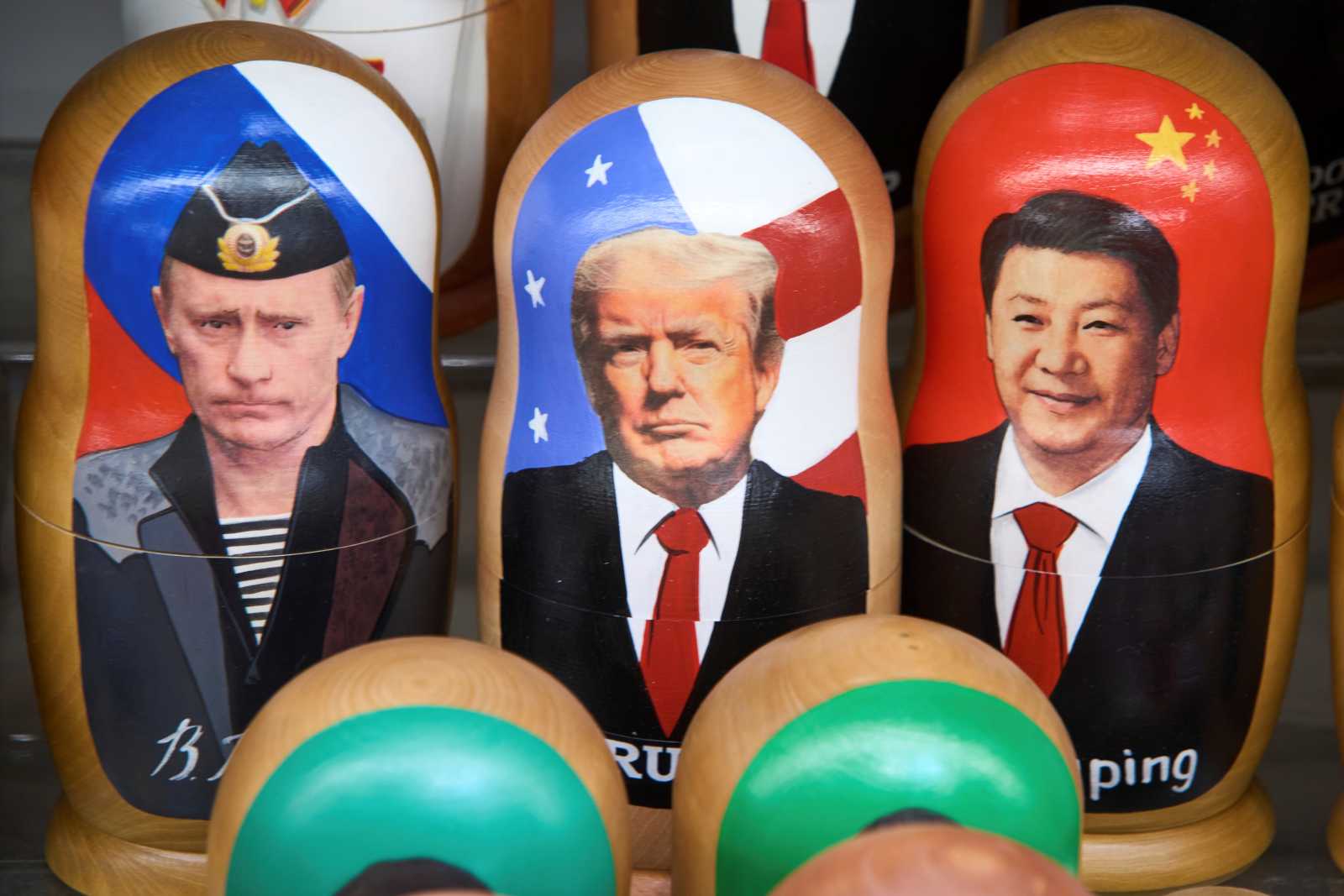
Oligarchs shape politics and the global economy
By oligarchs, we mean people who fuse wealth and power: individuals able to convert extraordinary wealth into power and power back into wealth, across borders.
In recent years, both the number of oligarchs and their average wealth have grown, enabling them to acquire multiple forms of power. By our estimates, 47 oligarchs have served as heads of state or government so far in 2026, many of them ruling autocratic regimes.
Drawing on World Bank and national accounts data, we estimate that oligarch-run states accounted for less than one-fifth of global economic output at the end of World War II. Today they account for something closer to three-fifths. Eight of the world’s top 20 economies are run by oligarchs, and most of them have autocratic tendencies. They are no longer a peripheral phenomenon. They are increasingly turning democracy, development and the international order into instruments for protecting their wealth and power.

If this trend continues, authoritarianism will rise and the self-government of societies will become increasingly devoid of meaning. Too many citizens today – in the United States, for example – have come to accept oligarchs and their overreach as normal or as an entertaining distraction. They are neither.
Sanctions are not enough, containment may be
The most superficially satisfying response to oligarchs’ wealth and power is eradication – through sanctions, prosecutions or asset seizures. However, this approach has proven severely limited in practice. Sanctions did not stop Mordashov from sailing his vessel through the Strait of Hormuz, nor have they meaningfully curtailed the power of Russia’s other heavily sanctioned oligarchs. Furthermore, it is structurally compromised: sanctions are a state instrument, imposed by outside powers, and subject to the same geopolitical calculation that oligarchs exploit.
What’s more: Oligarchs are rarely eliminated. They are merely replaced, as we have seen across resource-rich developing countries from Latin America to South Asia.
The necessary response is therefore containment: limiting their ability to convert wealth into power and power into wealth, while strengthening the institutions that constrain them. Two conditions are essential. First, containment must be global. Second, it cannot be left to governments alone; it requires a largely non-governmental response. We cannot expect governments already penetrated by oligarchs’ influence to lead the way out of it.
The fusion of wealth and power is legal – and that’s a problem
Institutions designed to constrain the illicit accumulation of wealth through corruption already exist – from intergovernmental bodies such as the OECD to NGOs and investigative journalism networks that have exposed, through the Panama and Pandora Papers, just how deeply oligarchs’ wealth is embedded in the global financial system.
Yet all of these efforts have one fundamental limitation: they can only target what is illegal. The conversion of wealth into power – and of power into private wealth – is entirely lawful in most jurisdictions. In 2010, US courts even ruled that political campaign spending constitutes protected free speech, effectively enshrining the fusion of money and politics in law.
Containing oligarchs’ influence will therefore require the emergence of a new, distributed and largely non-governmental coalition: a network of journalists, researchers, civil society organisations and financial watchdogs that exposes oligarchs’ networks and coordinates resistance across borders. This network would not need to be a single organisation, but it would need to perform several shared functions, such as mapping oligarchs’ wealth-power networks, exposing their cross-border enablers, coordinating pressure on gatekeepers and raising the reputational and financial cost of converting wealth into public power.
The purpose of containment is simple but essential: to reinforce the boundaries between wealth and power and to preserve the capacity of societies to govern themselves. This effort can only succeed through institutions strong enough to resist capture.
Do we have the nerve to build fences?
Oligarchs grow stronger under conditions of uncertainty, rising inequality and weakening institutions. Their greatest advantage, however, is not wealth or power as such. It is the growing belief that nothing can be done about either. This is precisely why it is ever more important to act.
Two things are required. First, societies need a clearer understanding of how oligarchs think and operate. A containment network must deploy the tools of modern financial and technological systems, using financial transparency, data analytics and, where applicable, artificial intelligence to trace wealth networks and impose friction on the conversion of wealth into power and of power into wealth.
Second, societies need to establish firm boundaries: clear limits on the conversion of wealth into power and on the transformation of power into private wealth. The challenge is not wealth itself nor power alone, but the fusion of the two.
Containment will not eliminate oligarchs. The task facing contemporary societies is to prevent their dominance from overwhelming the institutions on which stable, open societies depend. The question is no longer whether oligarchs will try to prosper and rule. They will. The question is whether free societies still have the nerve to put fences around them.
Literature
Lingelbach, D., and Rodríguez Guerra, V., 2026: Games without thrones: 8 leadership lessons from oligarchs.
De Gruyter.
Lingelbach, D., and Rodríguez Guerra, V., 2023: The oligarchs’ grip: fusing wealth and power. De Gruyter.
Lingelbach, D., and Rodríguez Guerra, V. (upcoming):
The oligarchs of the Americas: from the Conquistadores to Silicon Valley. De Gruyter.
David Lingelbach is the founder and chair of The Center for the Study of Oligarchs and a professor of entrepreneurship at The University of Baltimore. He was previously CEO of Bank of America’s businesses in the former Soviet Union and worked with oligarchs such as Vladimir Putin.
dlingelbach@oligarchcenter.org
Valentina Rodríguez Guerra is the founder and vice chair of The Center for the Study of Oligarchs. She is pursuing a PhD in management at Universidad de los Andes.
vrodriguez@oligarchcenter.org