Sustainable Development Goals
How Uzbekistan has achieved rapid SDG progress


Uzbekistan’s transformation is inseparable from the political shift that followed the sudden death of President Islam Karimov in 2016. Under Karimov’s authoritarian rule, the country’s economy stagnated. Shavkat Mirziyoyev, who had been prime minister under Karimov, succeeded him on a campaign promise of change.
“Mirziyoyev lifted certain restrictions on business and entrepreneurship that existed during Karimov’s era,” says Alisher Ilkhamov, the director of the UK-based civil-society organisation Central Asia Due Diligence. He acknowledges that Mirziyoyev’s economic reforms have had a real impact. “Back then, there was centralised currency exchange, whereas now the economy operates under a more liberal regime. These changes, it seems, provided an important boost to economic programmes and initiatives,” he says.
The progress Uzbekistan has made in providing access to education is also the result of decentralising and reducing state control in this area. The previous regime was very reluctant to grant foreign universities admission to the country. Yet under Mirziyoyev, various foreign universities from Europe, the United States and Asia have established numerous branch campuses in Uzbekistan, according to Alisher Ilkhamov. He stresses that this development has created new opportunities for students.
“At the very least, one can say that the situation has improved, particularly in higher education,” Ilkhamov says. “As for school education, consider the fact that children are no longer being sent out to pick cotton. Now schoolchildren can spend the whole year studying in the classroom rather than being distracted by these absurd cotton-picking campaigns. This alone, of course, contributes to improvement.”
Considerable remittances from abroad
Another factor driving Uzbekistan’s progress has been external rather than internal: migrant workers. According to the Central Bank of Uzbekistan, the total volume of remittances to the country from abroad in 2024 reached $ 14.8 billion, of which $ 11.5 billion came from Russia alone, where the majority of Uzbek migrant workers live. For comparison: in 2024, Uzbekistan’s GDP was at $ 115 billion.
As analyst Alisher Ilkhamov points out, remittances not only provide income but also fuel domestic consumption, create demand for local goods and services and stimulate job creation at home. In this sense, Uzbekistan’s SDG progress is partly built on the sacrifices of those working abroad. A female Uzbek migrant worker in Russia who spoke on condition of anonymity says: “My mother died of Covid-19 in 2021. I had to support my younger sisters myself. Despite measures having been tightened against labour migrants, I am not planning to leave Moscow, because back home I would not be able to earn between $ 1000 and $ 1100 a month as I do here. While being here, I have learned several trades and managed to study Russian to a level sufficient for communication and work.”
Agriculture as key sector
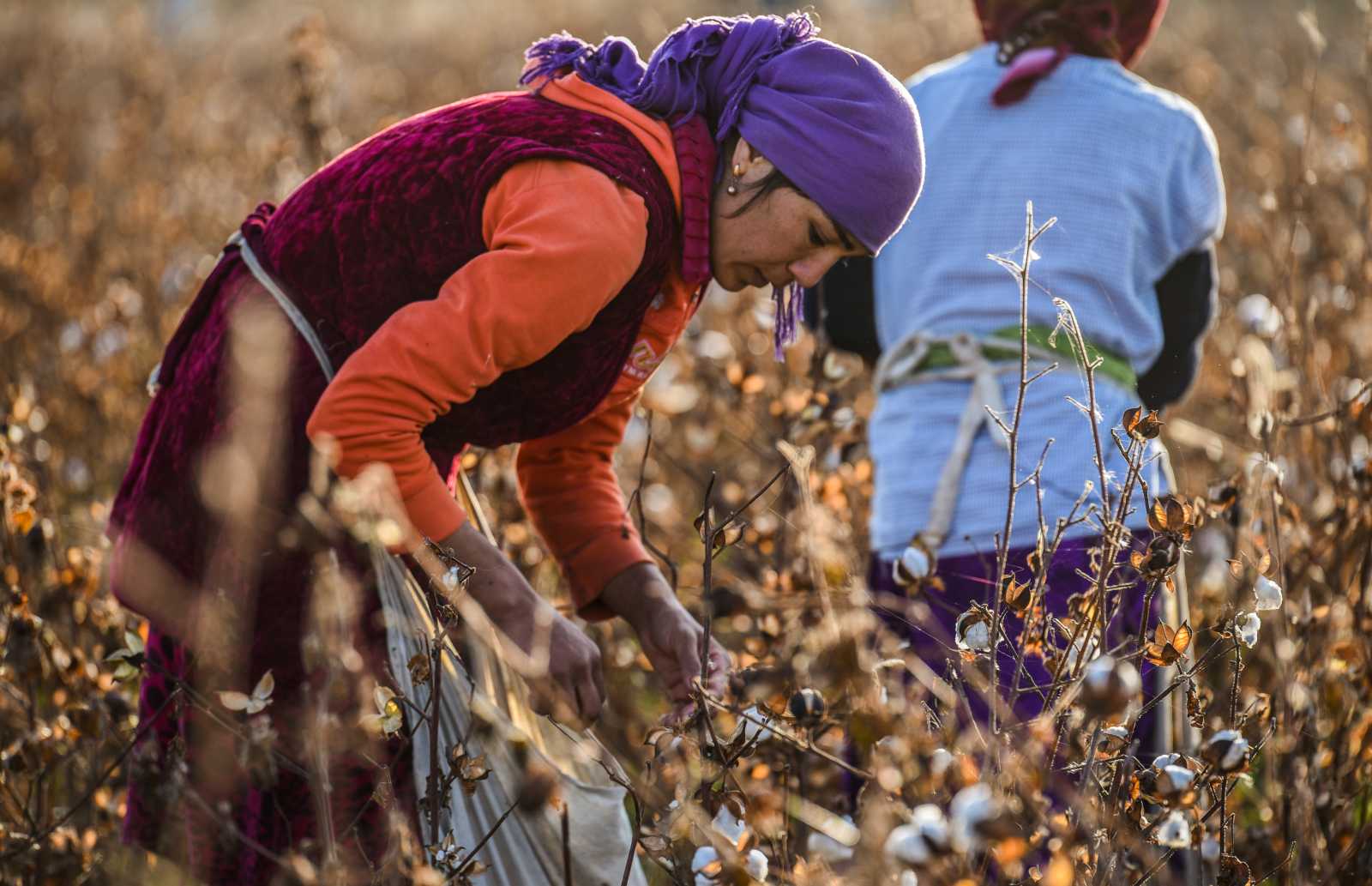
Some of the main challenges remain in the agricultural sector, which employs about 14 % of the population – a number that has fallen from 26 % in 2000. “Uzbekistan is only halfway there,” says Umida Niyazova, director of the Uzbek Forum for Human Rights, a civil-society organisation that focuses on labour rights. On the one hand, she says, Uzbekistan initiated reforms in many areas and became one of the largest recipients of funding from international financial institutions to implement reforms aimed at achieving sustainable development. On the other hand, she criticises the fact that “reforms in agriculture are being carried out in a half-hearted and poorly thought-out way”.
As an example, Umida Niyazova cites the state’s influence on the production of cotton, one of the country’s main export goods, and grain. She recalls that in 2020, the state declared that it would stop officially “ordering” cotton and grain production. “But in reality, the state continues to force farmers to grow only these crops even if it is unprofitable for them,” she says, adding that some farmers have been obliged to sell their harvests to designated companies that failed to pay, leaving once-prosperous farms bankrupt. Umida Niyazova argues that such policies reflect deeper systemic weaknesses and that rural poverty will persist unless there is genuine liberalisation.
The 2025 SDG Report highlights two areas where Uzbekistan is lagging significantly behind: hunger and energy. Food insecurity remains a problem for vulnerable groups, despite falling poverty rates.
World Bank data show that while poverty has declined, inequality has increased. Between 2022 and 2023, the incomes of the poorest 10 % of the population rose by just six percent, while the wealthiest 10 % enjoyed gains exceeding 30 %. Since food prices are rising faster than salaries and pensions, many households are struggling to secure adequate nutrition, undermining progress towards SDG2 “Zero hunger.”
Dependence on fossil fuels
Meanwhile, the country’s energy system is still plagued by chronic shortages. Uzbekistan is heavily dependent on fossil fuels. According to the International Energy Agency, 79 % of the country’s energy supply came from natural gas in 2023, followed by oil and coal. Renewables are growing but make up only a small fraction of the energy mix. Meanwhile the country has issues with outdated gas and electricity infrastructure.
“The power grid in Uzbekistan still runs mainly on natural gas, which is produced domestically rather than being imported, which is a big positive,” says Laurent Ruseckas, an analyst with S&P Global Commodity Insights. While expanding renewable energy production will take time and significant investment, the country seems to be on the right track, he says. “Uzbekistan has recently had considerable success in building large-scale solar generation with support from multilateral financial institutions and investment from companies such as Masdar and TotalEnergies,” he says. The analyst stresses that more investments will be needed in renewables, the electricity grid and natural gas production to make up for the decline in production at older gas fields.
In early 2024, the Uzbek government raised its 2030 target for electricity generated from renewable energy from 25 % to 40 % and more than doubled its goal for solar and wind capacity from 12 to 27 gigawatts. However, systemic reform in the energy sector has yet to materialise, so SDG7 “Affordable and clean energy” is still a long way off. In energy and other sectors, corruption, inefficiency and mismanagement add to the challenges.
Reforms must continue
All in all, despite ongoing struggles, the lives of ordinary Uzbeks have improved measurably in recent years. Small business opportunities have expanded, digital services have reduced corruption, and international partnerships have given education a new dynamism. However, rising inequality, persistent hunger, systemic energy problems and rural distress are reminders that reforms must go deeper if they are to last.
Fighting poverty will remain a major issue. In 2024, President Mirziyoyev announced a state programme whose name translates to “From Poverty to Prosperity”. The programme prioritises employment, sustainable sources of income and high-quality education, these being the main drivers of long-term poverty reduction. Mirziyoyev declared that more than 70 % of government spending would be directed towards achieving the Sustainable Development Goals.
It helps that Uzbekistan joined the International Comparison Program (ICP) in 2017, a World Bank-led initiative that allows countries to collect internationally comparable data on poverty and living standards. Under Karimov’s regime, Uzbekistan didn’t have reliable data on poverty, which made it impossible to compare the country’s social performance with that of its neighbours or countries worldwide. Later, with the assistance of the World Bank, Uzbekistan developed a national methodology to measure poverty, which painted a clearer picture of the challenges facing Uzbekistan’s society.
So far, Uzbekistan has proven that rapid progress is possible. But whether this progress can be consolidated into long-term transformation remains to be seen.
Link
World Bank: International Comparison Program:
Shahida Tulaganova is a producer, director and war reporter from Uzbekistan. She lives in the UK.
shahidayakub@gmail.com