Gender equality
Algeria’s legal recognition of women’s rights must be put into action


In a critical decision, Algeria officially lifted its reservation on Article 15(4) of the Convention on the Elimination of All Forms of Discrimination Against Women (CEDAW), a landmark international bill of rights for women, in August 2025. This article guarantees women the same rights as men with regard to freedom of movement and choice of residence. Algeria’s move marks a significant legal shift towards gender equality, particularly in a country where women’s autonomy in mobility and residence has long been constrained by patriarchal interpretations of family and moral codes.
Yet this development highlights the contradictions within Algeria’s gender landscape: even as the country expands its international commitments, its domestic laws and patriarchal practices continue to limit women’s autonomy. The Algerian Family Code, enacted in 1984, originally contained provisions treating women as dependants, such as Article 39’s duty of obedience. However, a 2005 reform repealed the obedience clause and introduced mutual spousal obligations and the right to include stipulations in marriage contracts, for instance concerning the wife’s right to work.
Some restrictive provisions persist: Article 11 of the Family Code still requires a wali (Arabic for legal male guardian) in marriage contracts, and judicial practice has at times treated alleged “disobedience” as relevant to divorce, maintenance or custody outcomes, limiting women’s autonomy in family life and by extension their freedom of movement. These residual structures reveal a tension between Algeria’s evolving international commitments and its conservative legal culture.
Algeria’s reform in focus
Ratified by Algeria in 1996, CEDAW has long featured in national debates on gender equality. Until August 2025, Algeria maintained a reservation to Article 15(4), citing conflicts with its Family Code – particularly the now-repealed Article 37, which addressed choice of residence – and with tradition. In August 2025, Algeria issued a Presidential Decree formally lifting that reservation and aligning domestic law with international norms.
In theory, the reform could have broad implications for women’s lived realities, particularly in cases of domestic violence, forced cohabitation and practices such as charging women with “abandonment of the marital home”, which have been used to shame or penalise women who leave abusive households. Removing the reservation provides new legal ground for advocates to challenge such restrictions on women’s mobility and residence.
Violence, mobility and the private sphere
Domestic violence and femicide remain among the most urgent threats to women’s safety in Algeria. According to Féminicides Algérie, between 2019 and 2024 a total of 315 women were killed. Most of these murders were perpetrated by men within the victims’ families: 42.6 % by partners or ex-partners and 27.7 % by relatives such as fathers, sons or brothers. These statistics underscore how violence is rooted in the private sphere and justified through patriarchal notions of control. These are not isolated tragedies, but symptoms of a social order that still treats women’s independence as against the rules.
For women seeking to live alone or to escape abusive households, this climate can be life-threatening, as leaving one’s family or husband is often seen as a moral affront that invites punishment. The 2020 femicide of Chaima Saadou, who was raped, murdered and later victim-blamed for leaving her home, became a stark symbol of impunity and societal misogyny. Her case ignited the #JusticePourChaima (Justice for Chaima) movement, which exposed Algeria’s entrenched culture of victim-blaming and the widening gap between legal reform and actual protections for women. The persistence of such violence illustrates that lifting Algeria’s CEDAW reservation must be accompanied by robust protection systems, including shelters, safe reporting mechanisms and law-enforcement accountability, if women are to exercise their right to freedom of movement without fear.
Women’s rights in Morocco, Tunisia and Egypt
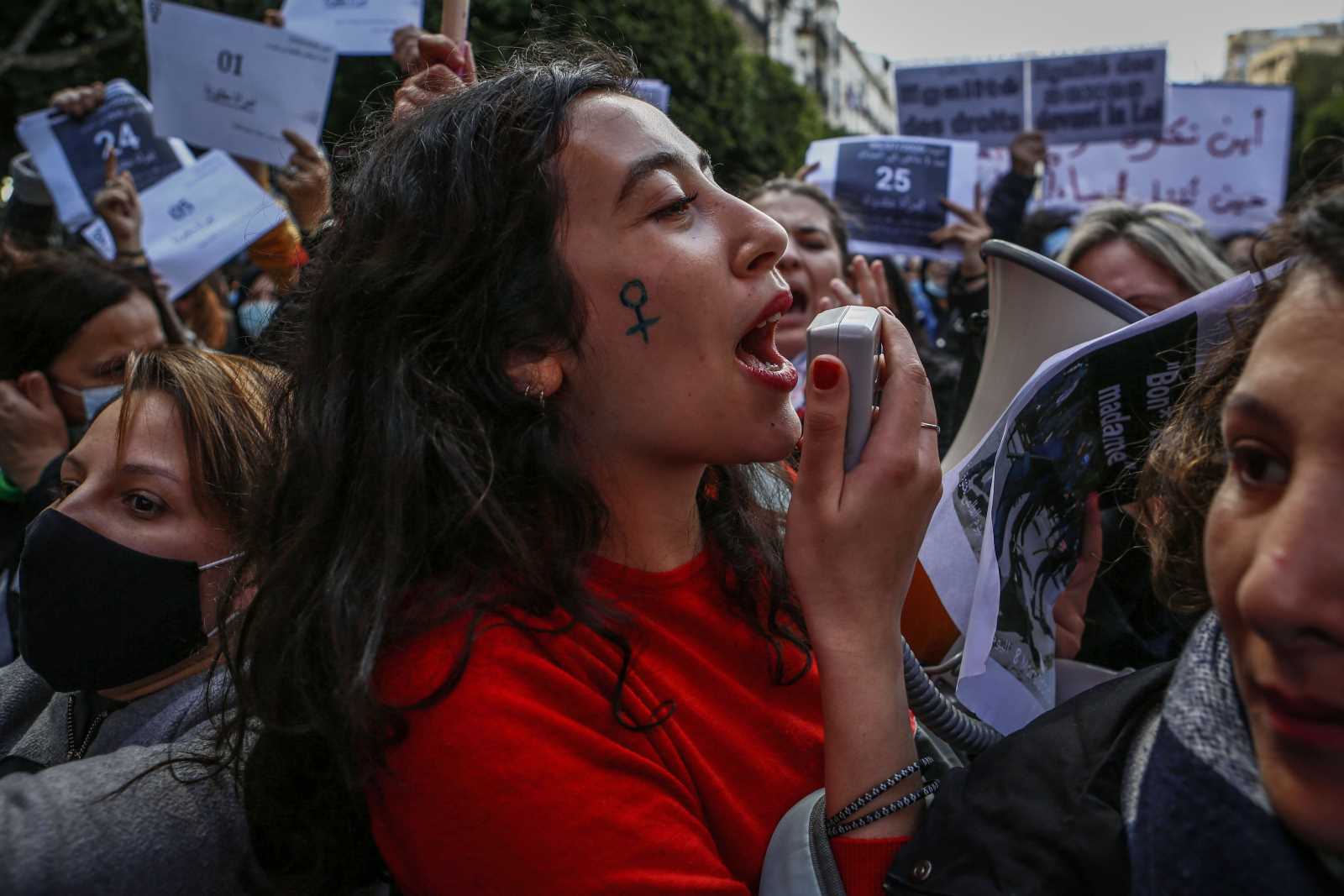
This tension is not unique to Algeria. Across North Africa, women’s rights have progressed unevenly, often caught between international pressure, religious interpretation and conservative social norms.
Morocco, for instance, undertook a landmark reform of its Family Code (Moudawana) in 2004, following sustained advocacy by women’s movements and international encouragement. The reform replaced the 1957–58 code and introduced major advances: it raised the legal age of marriage for women from 15 to 18, allows women to initiate divorce, recognises joint responsibility between spouses and removed the legal duty of obedience. Despite these gains, significant gaps persist in inheritance rights, and judges retain discretion to authorise underage marriages; both of these issues reflect the continued influence of patriarchal norms. Feminist organisations have since renewed calls for comprehensive reform to align the Moudawana with Article 19 of the 2011 Constitution, which enshrines equality between men and women. Yet progress remains slow due to political and cultural resistance.
Tunisia, often regarded as the most progressive Arab country on women’s rights, established its reformist legacy with the 1956 Personal Status Code, which abolished polygamy, required mutual consent in marriage and introduced judicial divorce. Tunisia ratified the CEDAW in 1985 and lifted its reservations in 2014 following the adoption of a new constitution that explicitly guarantees equality between men and women. However, since President Kais Saied’s consolidation of power in 2021, activists have reported regression in women’s rights, reduced funding for gender-based programmes and stalled implementation of the 2017 Law on Eliminating Violence Against Women. In recent years, the government has increasingly invoked national security and public order to justify restrictions on civil society organisations, further narrowing the space for feminist activism.
Egypt presents a complex picture. It ratified CEDAW in 1981, but maintains reservations to several articles, including Article 16 on marriage and family relations and parts of Article 2, citing the need to comply with Islamic Shari’a. In 2021, a draft Personal Status Law proposed by the government sparked widespread opposition from civil society, including the Egyptian Centre for Women’s Rights (ECWR), due to provisions seen as likely to restrict women’s legal capacity. They include men’s guardianship over minor children as well as men’s control over marriage contracts and women’s freedom of movement. The bill was later withdrawn. Nonetheless, many laws still permit male guardians or husbands to control key decisions over women’s mobility, divorce and child custody under existing personal status frameworks.
Algeria thus sits at an instructive midpoint between its neighbours. Its legal reforms echo Morocco’s incremental progress but lack Tunisia’s institutional coherence. Symbolic compliance with international frameworks exists, but implementation and cultural transformation remain elusive.
Algeria’s Family Code needs to be reformed
The lifting of Algeria’s reservation on Article 15(4) is a promising step, but its practical impact will depend on aligning domestic law and practice with international standards. To translate this reform into real change, Algeria must prioritise revising or repealing Family Code provisions that sustain patriarchal guardianship structures, notably the codified authority of the husband as the head of the family. Judicial and administrative training in gender-sensitive interpretation is equally vital to ensure that judges, prosecutors and police uphold the reform’s spirit rather than default to patriarchal precedent.
Socially, the reform will encounter resistance. Even where laws change, stigma remains powerful. Women who seek independence or leave abusive relationships are often met with ostracism, economic insecurity or even violence. Without parallel social transformation, legal reform is at risk of remaining symbolic.
Algeria must therefore accompany legal change with broad-based awareness campaigns targeting both men and women and stronger protection mechanisms. Expanding access to safe shelters, legal aid and psychosocial support for survivors of gender-based violence would not only provide immediate protection but also signal a societal shift towards recognising women’s autonomy as a collective gain rather than a threat to traditional social norms.
Finally, Algeria’s progress must be anchored in accountability. Internationally, the country’s decision enhances its credibility within UN and African Union human-rights frameworks. However, as Tunisia and Morocco have shown, ratification and reform are only meaningful when backed by oversight from civil society and regional bodies. Consequently, partnerships with feminist organisations, transparent data on gender-based violence and measurable progress indicators should guide the next phase of implementation.
Source
UN, 1979: Convention on the Elimination of All Forms of Discrimination Against Women.
Khadidja Kelalech is a postdoctoral researcher in gender, race and migration in the MENA region, with a specific focus on Algeria.
kelalechkhadidja@gmail.com